
Influence of Resistance Spot Welding on Tensile Shear Strength and Intermetallic Compound Formation in Dissimilar SPFH780 Low−Alloy Carbon Steel and 5052 Aluminum Alloy Joints
Keywords:
Resistance Spot−Welded, SPFH780 Low−Alloy Carbon Steel, 5052 Aluminum Alloy, Intermetallic Compound, Tensile Shear StrengthAbstract
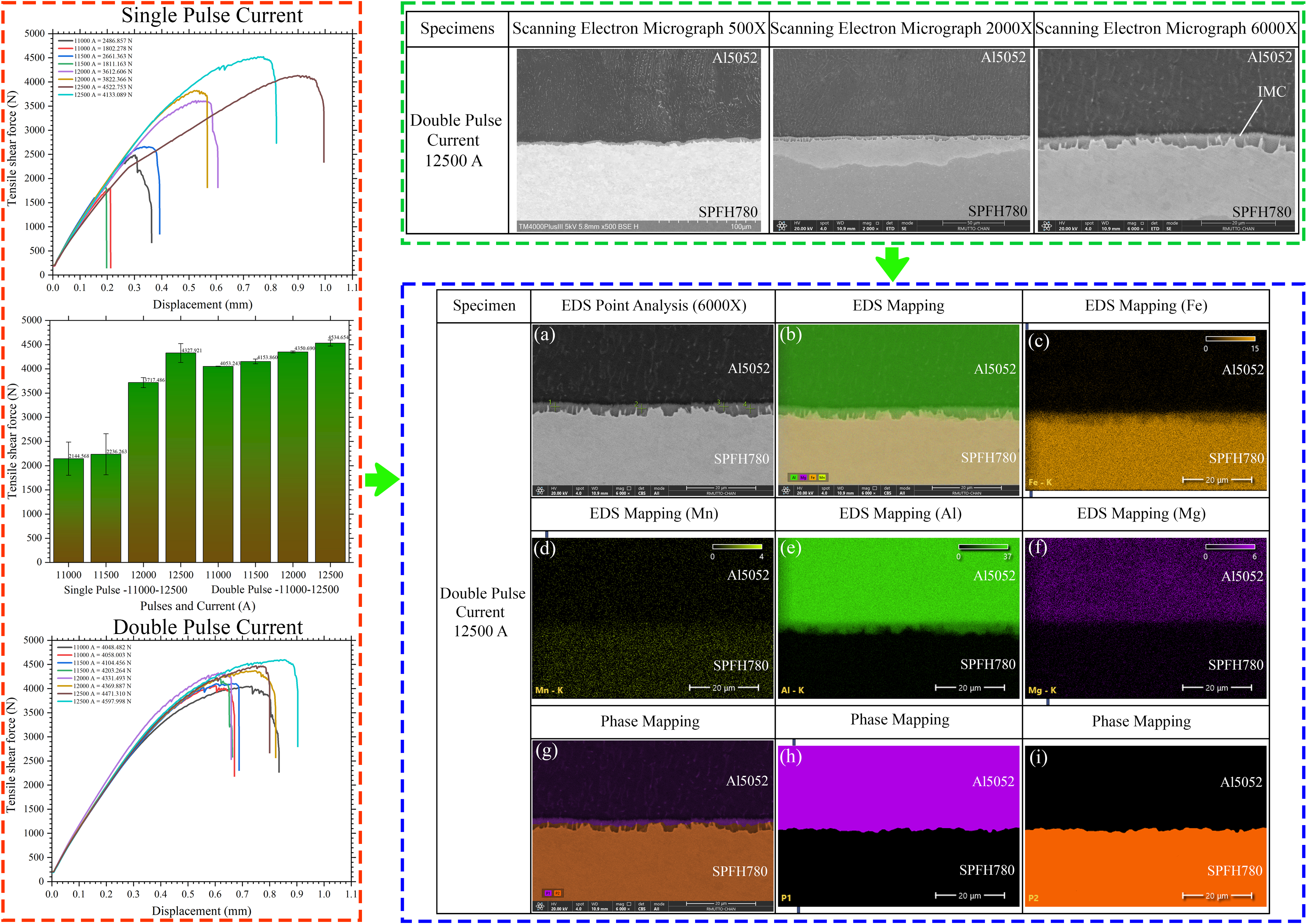
This research investigates the influence of welding current levels and pulse configurations on the mechanical properties and intermetallic compound (IMC) formation behavior at the interface of resistance spot−welded (RSW) joints between SPFH780 low−alloy carbon steel 1.60 mm thick and 5052 aluminum alloy 1.50 mm thick. A comparative study was conducted using single−pulse and double−pulse current modes at intensities of 11000, 11500, 12000, and 12500 Amperes (A). The results demonstrate that double−pulse RSW yields significantly higher average tensile−shear strengths than single−pulse welding across all tested current levels. Notably, a peak average tensile shear strength of 4534.654 N was achieved at a current of 12500 A using the double−pulse mode. This improvement is attributed to the superior thermal cycle control and the reduction of excessive heat accumulation inherent in the double−pulse delivery, which effectively limits the growth of brittle Fe2Al5 and FeAl3 IMC layers to an optimal thickness. Microstructural analysis via scanning electron microscopy (SEM) and energy−dispersive X−ray spectroscopy (EDS) further revealed that increasing the welding current directly enhances heat input, thereby expanding the weld nugget size and improving the mechanical load−bearing capacity of the joints. In conclusion, the double−pulse welding process serves as a highly effective technique for enhancing mechanical performance and regulating interfacial IMC formation in dissimilar metal joining.
References
L. Walker, N. Avedissian, C. Vanderbilt, D. Paolini, and W. Zhang, “Effect of Fe−Al Intermetallics on Fatigue Properties of Aluminum to Steel Dissimilar Spot Welds,” International Journal of Fatigue, vol. 187, p. 108434, Oct. 2024, doi: 10.1016/j.ijfatigue.2024.108434.
F. Teng, P. Huan, X. Wang, Z. Jiang, Q. Zhang, R. Liu, D. Lv, and H. Di, “Improving the Mechanical Properties of an Al–Si−Coated 22MnB5 Steel Resistance Spot Welding Joint by Adding Ni Foil to Suppress Fe–Al IMCs and δ−Ferrite,” Journal of Materials Research and Technology, vol. 37, pp. 3615–3624, Aug. 2025, doi: 10.1016/j.jmrt.2025.07.058.
A. Kapil, A. Vivek, and G. Daehn, “Role of Zinc Coating on Joint Properties in Impact Spot Welded Al 6111 Aluminum Alloy to Galvanized High−Strength Low−Alloy Steel,” Journal of Advanced Joining Processes, vol. 11, p. 100276, Jan. 2025, doi: 10.1016/j.jajp.2024.100276.
W. Peng, D. Du, A. Dong, G. Wu, Z. Shen, B. Sun, N. Chen, H. Teng, S. Wang, and Y. Xie, “Mechanism of Flash Nickel Interlayer in Mitigating LME in Resistance Spot Welding of High−Strength Steel with Zn–Al–Mg Coating,” Journal of Materials Research and Technology, vol. 40, pp. 1248–1264, Jan. 2026, doi: 10.1016/j.jmrt.2025.12.246.
Z. Li, Y. Wang, Y. Chen, F. Cheng, D. Yang, G. Xie, and H. Yi, “Critical Influence of FeAl and α−Fe Phases in Coating Layers on Resistance Spot Weldability of Al–Si Coated Press−Hardening Steels,” Journal of Materials Research and Technology, vol. 41, pp. 4015–4030, Mar. 2026, doi: 10.1016/j.jmrt.2026.02.054.
S. Wang, Z. Yuan, Y. Meng, and B. Ge, “Failure Mechanisms of Intermetallic Compounds in Aluminum−Steel Resistance Spot Welds Utilizing Advanced Electron Microscopy Techniques,” Journal of Materials Research and Technology, vol. 35, pp. 5216–5221, Mar. 2025, doi: 10.1016/j.jmrt.2025.02.178.
L. Shi, J. Kang, X. Chen, A. S. Haselhuhn, D. R. Sigler, and B. E. Carlson, “Determination of Fracture Modes in Novel Aluminum−Steel Dissimilar Resistance Spot Welds,” Procedia Structural Integrity, vol. 17, pp. 355–362, 2019, doi: 10.1016/j.prostr.2019.08.047.
Y. G. Kim, B. J. Jo, J. S. Kim, and I. J. Kim, “A Study on Dissimilar Welding of Aluminum Alloy and Advanced High Strength Steel by Spot Welding Process,” International Journal of Precision Engineering and Manufacturing, vol. 18, no. 1, pp. 121–126, Jan. 2017, doi: 10.1007/s12541−017−0015−6.
C. Qian, H. Ghassemi−Armaki, L. Shi, J. Kang, A. S. Haselhuhn, and B. E. Carlson, “Competing Fracture Modes in Al−Steel Resistance Spot Welded Structures: Experimental Evaluation and Numerical Prediction,” International Journal of Impact Engineering, vol. 185, p. 104838, Mar. 2024, doi: 10.1016/j.ijimpeng.2023.104838.
Y. Che, L. Wang, D. Sun, H. Li, and W. Geng, “Microstructures and Mechanical Properties of Resistance Spot−Welded Steel/Aluminum Alloy Joints with Process Tapes,” Journal of Materials Engineering and Performance, vol. 27, no. 11, pp. 5532–5544, Nov. 2018, doi: 10.1007/s11665−018−3595−0.
M. Fodorné Cserépi and Á. Meilinger, “The Effect of RSW Technological Parameters to the Properties of Aluminium/Steel Hybrid Joints,” Multidiszciplináris Tudományok, vol. 14, no. 3, pp. 202–210, 2024, doi: 10.35925/j.multi.2024.3.18.
W. Cai, Q. Chen, Y. Wang, S. Dong, and P. Luo, “Microstructural and Mechanical Characterization of Steel−DP780/Al−5052 Joints Formed Using Resistance Element Welding with Concealed Rivet Cover,” Composites and Advanced Materials, vol. 31, 2022, doi: 10.1177/26349833221101076.
S. M. Hong, S. Tashiro, H. S. Bang, and M. Tanaka, “A Study on the Effect of Current Waveform on Intermetallics Formation and the Weldability of Dissimilar Materials Welded Joints (AA5052 Alloy—GI Steel) in AC Pulse GMAW,” Metals, vol. 11, no. 4, p. 561, Apr. 2021, doi: 10.3390/met11040561.
M. Li, Y. Wang, W. Tao, and S. Yang, “A Novel Strategy for Realizing Reliable Welding of Aluminum−Steel,” Welding Journal, vol. 102, no. 11, pp. 293s–312s, Nov. 2023, doi: 10.29391/2023.102.022.
L. Chen and J. Liu, “Optimisation and Study of a Welding Process for Aluminium and Galvanised Steel Based on Resistance Welding,” in Proceedings of the Institution of Mechanical Engineers, Part C: Journal of Mechanical Engineering Science, vol. 238, no. 13, 2024, doi: 10.1177/09544062241226792.
B. Lara, R. Giorjao, H. Ghassemi−Armaki, and A. Ramirez, “Fe–Al Intermetallic Suppression of Dissimilar RSW Joints Using Stainless−Steel Interlayers,” Science and Technology of Welding and Joining, vol. 28, no. 6, pp. 461–467, 2023, doi: 10.1080/13621718.2023.2176046.
C1.1M/C1.1:2019, “Recommended Practices for Resistance Welding,” (2019).
M. Fodorné Cserépi and Á. Meilinger, “Effect of Intermetallic Compound Layer Size on Al/Steel Spot Weld Properties,” Pollack Periodica, vol. 21, no. 1, 2026, doi: 10.1556/606.2026.01507.
H. Okamoto, P. R. Subramanian, L. Kacpzak, and T. B. Massalski, Binary Alloy Phase Diagram Fe-Al, Materials Park, OH, USA: ASM International, 2001.
R. Hatano, T. Ogura, T. Matsuda, T. Sano, and A. Hirose, “Relationship Between Intermetallic Compound Layer Thickness with Deviation and Interfacial Strength for Dissimilar Joints of Aluminum Alloy and Stainless Steel,” Materials Science and Engineering: A, vol. 735, pp. 361–366, Sep. 2018, doi: 10.1016/j.msea.2018.08.065.
N. Chen, M. Wang, H. P. Wang, Z. Wan, and B. E. Carlson, “Microstructural and Mechanical Evolution of Al/Steel Interface with Fe2Al5 Growth in Resistance Spot Welding of Aluminum to Steel,” Journal of Manufacturing Processes, vol. 34, pp. 424–434, Aug. 2018, doi: 10.1016/j.jmapro.2018.06.024.
Downloads
Published
How to Cite
Issue
Section
License
Copyright Notice articles, information, images, etc. was published in this Journal of Manufacturing and Management Technology is a copyright of the Journal of Manufacturing and Management Technology. If any person or deparment wants to bring all or part of it for publish or take any action. Authorization is required in written form from the Journal of Manufacturing and Management Technology only.


