
Appraisal of Suitability of Geosynthetic Clay Liner in Composite Base Lining System of Phosphogypsum Dumping Yard
Article Sidebar
Main Article Content
Abstract
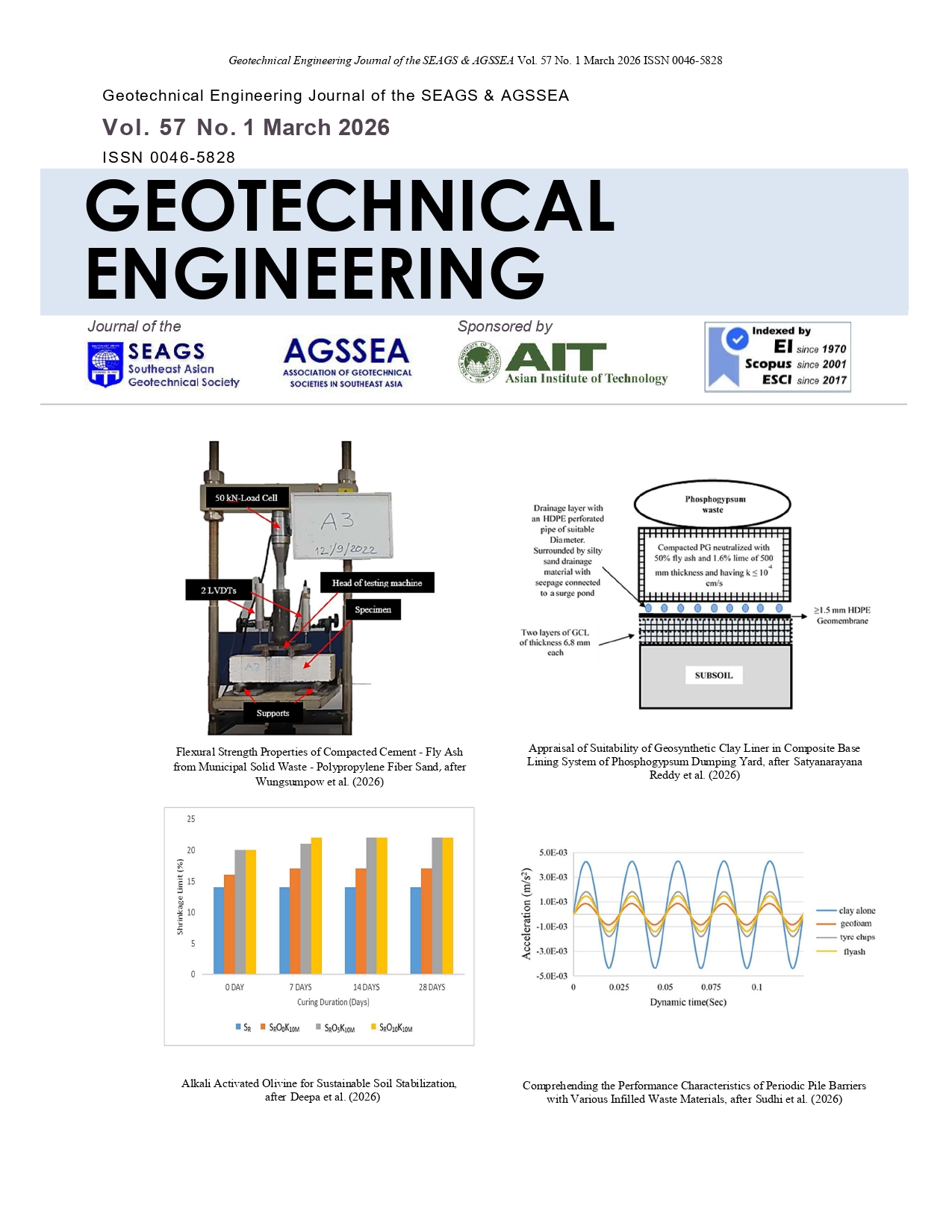
Stockpiling of phosphogypsum without proper measures in the past has led to subsoil and groundwater contamination. With the recent development in regulations in some countries, dumping of phosphogypsum directly on land is prohibited due to its contamination and leaching characteristics. The Central Pollution Control Board (CPCB) of India has recommended a composite base liner system for the disposal of phosphogypsum. The lower part of the composite liner system shall comprise compacted clay or compacted amended soil or any other equivalent soil of permeability, k ≤ 10-9 m/s, and have a thickness of 60 cm. In the upper part of the composite liner system, a layer of mechanically compacted and neutralized phosphogypsum is placed above the drainage layer. In the present work, the efficacy of geosynthetic clay liner (GCL) is evaluated for use in the lower part of the composite liner system, which can be an option in case suitable clay is not available locally. The study indicated the need of using two layers of GCL to sustain the effect of possible phosphogypsum contamination and satisfy the requirement of permittivity of 60 cm thick compacted clay liner.
Article Details

This work is licensed under a Creative Commons Attribution-NonCommercial-NoDerivatives 4.0 International License.
Copyright © 2019 Association of Geotechnical Societies in Southeast Asia (AGSSEA) - Southeast Asian Geotechnical Society (SEAGS).
