
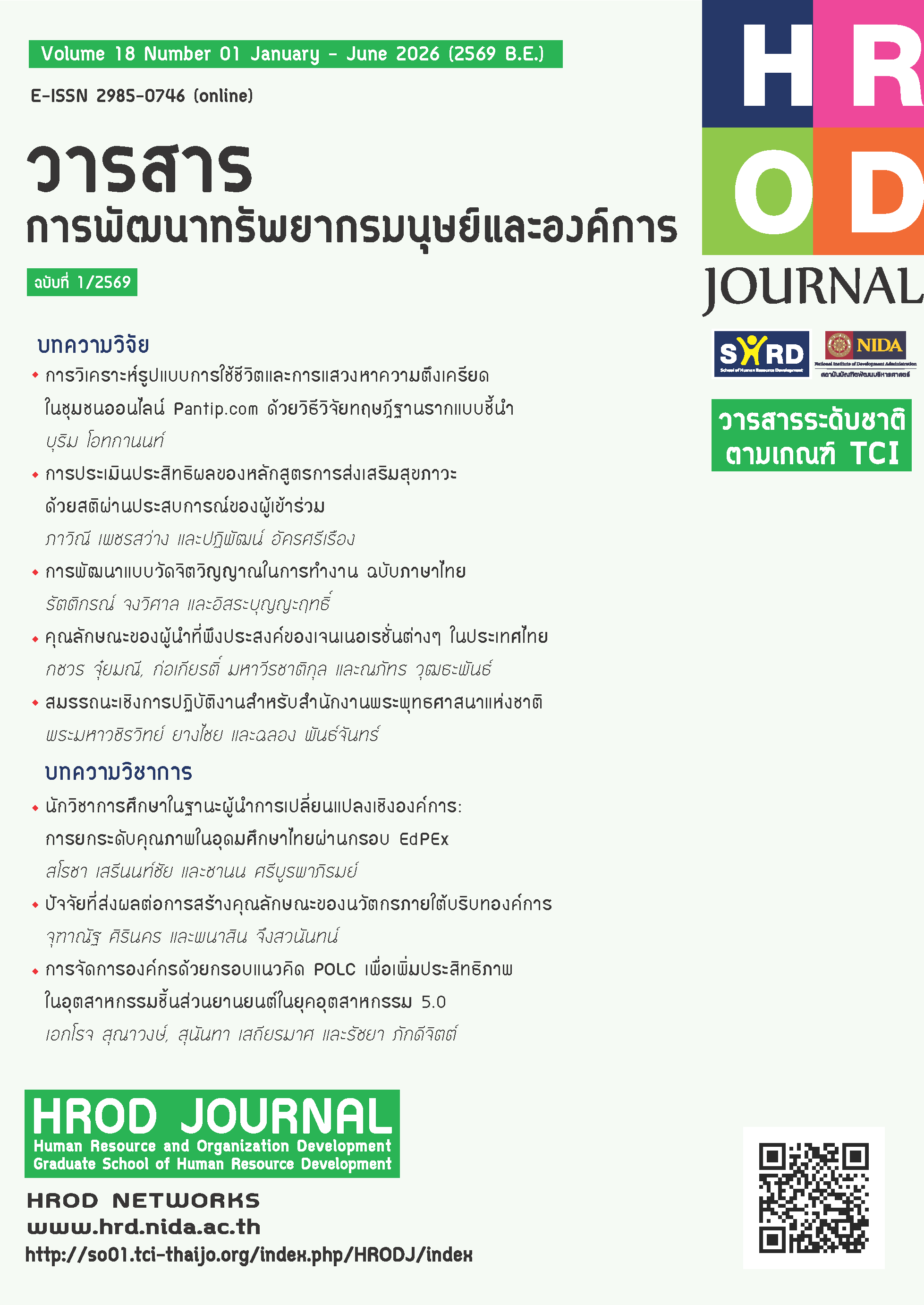
Factors Influencing the Development of Innovator Characteristics in Organizational Contexts
Article Sidebar
Main Article Content
Abstract
The ability to create innovation has become an essential competency for today’s workforce in enhancing organizational competitiveness. Therefore, this academic article examines the relationship between transformational leadership, work environment, and innovative work behavior. The literature review reveals that transformational leadership behaviors, combined with the creation of environments conducive to creative thinking, serve as a critical mechanism for enhancing employees' innovative work behavior. Consequently, recommendations have been proposed for organizational management to promote employees’ innovator characteristics, which emerge from innovative work behavior, with transformational leadership and a work environment as key factors. These propositions, derived from the authors’ conceptual framework, provide practical implications for both leader and organizational roles. Readers may apply these recommendations to empirically test hypotheses and explore management approaches adaptable to the policies of public and private organizations that emphasize employee innovation, or to provide them as guidelines for research aimed at enhancing workforce capabilities and cultivating a culture of self-development within organizations.
Article Details

This work is licensed under a Creative Commons Attribution-NonCommercial-NoDerivatives 4.0 International License.
1) The content of article in HROD journal is the author’s wholly responsibility to research, analyze, summarize, compile, and reference data. The editorial department will not be responsible in anyway.
2) The submitted articles in HROD journal must be unpublished before and must not be currently under consideration for publication elsewhere. If it is detected for its repetition, the author must be responsible for infringement of copyright.
3) Authors will be asked to transfer copyright of the article to the Publisher. The article is prohibited to reproduce all or part of the text, unless allowed.
References
กรมอุตุนิยมวิทยา. (2563). ประกาศกรมอุตุนิยมวิทยา เรื่อง นโยบายด้านการส่งเสริม บริหารจัดการนวัตกรรม และความคิดสร้างสรรค์ ลงวันที่ 23 มีนาคม พ.ศ. 2563. https://tmd.go.th/media/pmqa-pdf/pmqa-0042.pdf
ก้องภพ ขันติพงศ์พันธุ์. (2561). อิทธิพลของภาวะผู้นำการเปลี่ยนแปลงและองค์การแห่งความยั่งยืนต่อพฤติกรรมการสร้างสรรค์นวัตกรรม: กรณีศึกษาพนักงานของบริษัทในกลุ่มสมบูรณ์. วารสารเครือข่ายส่งเสริมการวิจัยทางมนุษยศาสตร์และสังคมศาสตร์, 1(3), 45–57. https://so06.tci-thaijo.org/index.php/hsrnj/article/view/252454
เกศแก้ว ชัยชุน และ ฐิติมา ไชยะกุล. (2565). ปัจจัยที่มีอิทธิพลต่อพฤติกรรมการทำงานเชิงนวัตกรรมของพนักงานในอุตสาหกรรมการบริการด้านการผลิตอุปกรณ์อิเล็กทรอนิกส์ ในเขตนิคมอุตสาหกรรมแหลมฉบัง จังหวัดชลบุรี. วารสารบริหารธุรกิจและภาษา, 10(2), 77–89. https://so06.tci-thaijo.org/index.php/TNIJournalBA/article/view/255960
เกียรติศักดิ์ ศุภรัตน์ และ กล้าหาญ ณ น่าน. (2566). สภาพแวดล้อมในการทำงานที่ส่งผลต่อพฤติกรรมการสร้างนวัตกรรม ในการทำงานของข้าราชการครูประถมศึกษา. Strategic Perspectives on Business and Marketing Management, 10(1), 20–35. https://so05.tci-thaijo.org/index.php/mmr/article/view/262691
จตุรภัทร วงศ์สิริสถาพร. (2567). อิทธิพลภาวะผู้นำการเปลี่ยนแปลง การจัดการนวัตกรรมเชิงกลยุทธ์ ที่ส่งผลต่อผลการดำเนินงานของธุรกิจ: กรณีศึกษาธุรกิจผลิตเซรามิกขนาดกลางและขนาดย่อมในจังหวัดลำปาง. วารสารปัญญาภิวัฒน์, 16(1), 49–61. https://so05.tci-thaijo.org/index.php/pimjournal/article/view/264249
ชชพงษ์ ชัชวาล, คณน ไตรจันทร์, และ อิศรัฏฐ์ รินไธสง. (2561). ปัจจัยเชิงสาเหตุที่มีผลต่อพฤติกรรมการสร้างสรรค์นวัตกรรมของพนักงานองค์กรปกครองส่วนท้องถิ่นในภาคใต้ของประเทศไทย. วารสารเทคโนโลยีภาคใต้, 11(1), 113–124. https://so04.tci-thaijo.org/index.php/journal_sct/article/view/86608
ฐิติพร สุรินธรรม และ วาสินี วิเศษฤทธิ์. (2024). ปัจจัยทำนายพฤติกรรมการทำงานที่เน้นนวัตกรรมของพยาบาลวิชาชีพ โรงพยาบาลมหาวิทยาลัยของรัฐ. วารสารวิจัยสุขภาพและการพยาบาล (วารสารวิทยาลัยพยาบาลบรมราชชนนี กรุงเทพ), 40(3), 121–131. https://he01.tci-thaijo.org/index.php/bcnbangkok/article/view/274516
นุษณา ณ พายัพ, วิลาสินี ธนพิทักษ์, ธนิตา แซ่ซี, ณัชญ์ศมน จิรังวรพจน์, และ นฤมล เอียดสุย. (2568). อิทธิพลของพฤติกรรมเชิงนวัตกรรมและจริยธรรมในการทำงานที่มีผลต่อผลการปฏิบัติงานของมัคคุเทศน์ใน 3 จังหวัดชายแดนใต้. วารสารสังคมศาสตร์และวัฒนธรรม, 9(5), 96–106. https://so06.tci-thaijo.org/index.php/JSC/article/view/284151
บริษัท ซีพี ออลล์ จำกัด (มหาชน). (2565). ประกาศ ที่ CIC.03/2566 เรื่อง นโยบายนวัตกรรมและการสร้างคุณค่า. https://www.cpall.co.th/wp-content/uploads/2023/02/Innovation-Policy-TH.pdf
ปรมาภรณ์ ตันสุขชัย และ จุฑามาศ ทวีไพบูลย์วงษ์. (2567). อิทธิพลของภาวะผู้นำการเปลี่ยนแปลง บรรยากาศการสร้างนวัตกรรมและความผูกพันของพนักงานที่มีผลต่อพฤติกรรมเชิงนวัตกรรมของพนักงานกลุ่มบริษัทผลิตพลังงานไฟฟ้าแห่งหนึ่งในภาคตะวันออก. สักทอง : วารสารมนุษยศาสตร์และสังคมศาสตร์, 30(4), 197–213. https://so05.tci-thaijo.org/index.php/tgt/article/view/263942
ปิยวุฒิ คิดมุ่งทางดี, ธนพล ก่อฐานะ, พาโชค เลิศอัศวภัทร, และ โอปอล์ สุวรรณเมฆ. (2567). ภาวะผู้นำ การแบ่งปันองค์ความรู้ บรรยากาศในองค์การ พฤติกรรมการสร้างสรรค์นวัตกรรมในการทำงานที่มีผลต่อประสิทธิภาพการทำงานของพนักงานธุรกิจก่อสร้างในประเทศไทย. วารสารรัฐศาสตร์ มหาวิทยาลัยราชภัฏสวนสุนันทา, 7(2), 337–351. https://so04.tci-thaijo.org/index.php/polssru/article/view/275580
ปีย์วรา พานิชวิทิตกุล. (2564). มิติของพฤติกรรมการทำงานเชิงนวัตกรรมในการเปลี่ยนผ่านทางดิจิทัล. วารสารบริหารธุรกิจและการบัญชี มหาวิทยาลัยขอนแก่น, 5(3), 69–96. https://so04.tci-thaijo.org/index.php/kkbsjournal/article/view/248992
พิมพ์ชนก หงษาวดี และ เพ็ญวรา ชูประวัติ. (2565). ความต้องการจำเป็นของการพัฒนาครูโรงเรียนหอวังตามแนวคิดคุณลักษณะนวัตกร. วารสารครุศาสตร์ปริทรรศน์ คณะครุศาสตร์ มหาวิทยาลัยมหาจุฬาลงกรณราชวิทยาลัย, 9(2), 243–252. https://so02.tci-thaijo.org/index.php/EDMCU/article/view/249578
รวินท์นิภา สว่างโลก และ จุฑามาศ ทวีไพบูลย์วงษ์. (2567). อิทธิพลของภาวะผู้นำการเปลี่ยนแปลง ทุนทางจิตวิทยา และการเสริมสร้างพลังอำนาจทางจิตวิทยา ที่มีต่อพฤติกรรมการทำงานเชิงนวัตกรรมของพนักงาน. วารสารเศรษฐศาสตร์และบริหารธุรกิจ มหาวิทยาลัยทักษิณ, 16(1), 187–204. https://doi.org/10.55164/ecbajournal.v16i1.265518
ลดาวรรณ หัทยาวัฒน์ และ สมโภชน์ เอี่ยมสุภาษิต. (2563). ความสัมพันธ์ระหว่างบุคลิกภาพห้าองค์ประกอบ สภาพแวดล้อมในการทำงาน และการรับรู้การสนับสนุนจากองค์การ กับพฤติกรรมการสร้างสรรค์นวัตกรรมของพนักงานธนาคารพาณิชย์. วารสารมนุษยศาสตร์และสังคมศาสตร์ วไลยอลงกรณ์ ในพระราชูปถัมภ์, 15(2), 99–110. https://so06.tci-thaijo.org/index.php/vrurdihsjournal/article/view/243640
ศิขริน เลขาวิจิตร และ รัชนีวรรณ วนิชย์ถนอม. (2560). ความสัมพันธ์ระหว่างภาวะผู้นำการเปลี่ยนแปลงต่อพฤติกรรมการสร้างสรรค์นวัตกรรมของข้าราชการครู โดยมีสภาพแวดล้อมในการทำงานเป็นตัวแปรสื่อ และการเสริมสร้างพลังอำนาจในเชิงจิตวิทยาเป็นตัวแปรกำกับ. วารสารพฤติกรรมศาสตร์, 23(1), 41–54. https://so06.tci-thaijo.org/index.php/BSRI/article/view/5752
สาธิต สุวรรณโสภา และ วงศ์ธีรา สุวรรณิน. (2564). ภาวะผู้นำการเปลี่ยนแปลงและสภาพแวดล้อมในการทำงานที่ส่งผลต่อพฤติกรรมการสร้างสรรค์นวัตกรรมของพนักงานบริษัทลีสซิ่งในเขตกรุงเทพมหานคร. วารสารบริหารธุรกิจและสังคมศาสตร์ มหาวิทยาลัยรามคำแหง, 4(1), 110–125. https://so02.tci-thaijo.org/index.php/ibas/article/view/244931
สำนักงานนวัตกรรมแห่งชาติ (องค์การมหาชน). (2565, 7 กรกฎาคม). ภารกิจของเรา. https://www.nia.or.th/missionnia
Al Wali, J., Muthuveloo, R., Teoh, A. P., & Al Wali, W. (2023). Disentangling the relationship between employees’ dynamic capabilities, innovative work behavior and job performance in public hospitals. International Journal of Innovation Science, 15(2), 368–384. https://doi.org/10.1108/IJIS-01-2022-0012
Amabile, T. M., Conti, R., Coon, H., Lazenby, J., & Herron, M. (1996). Assessing the work environment for creativity. Academy of Management Journal, 39(5), 1154–1184. https://www.jstor.org/stable/256995
Avolio, B. J., Bass, B. M., & Jung, D. I. (1999). Re-examining the components of transformational and transactional leadership using the Multifactor Leadership Questionnaire. Journal of Occupational and Organizational Psychology, 72(4), 441–462. https://doi.org/10.1348/096317999166789
Ayoub, A. E. A. H., Almahamid, S. M., & Al Salah, L. F. (2023). Innovative work behavior scale: Development and validation of psychometric properties in higher education in the GCC countries. European Journal of Innovation Management, 26(1), 119–133. https://doi.org/10.1108/EJIM-04-2021-0176
Bandura, A. (1977). Social learning theory. Prentice Hall.
Bandura, A. (1986). Social foundations of thought and action: A social cognitive theory. Prentice Hall.
Bass, B. M. (1990). From transactional to transformational leadership: Learning to share the vision. Organizational Dynamics, 18(3), 19–31. https://doi.org/10.1016/0090-2616(90)90061-S
Bass, B. M. (1999). Two decades of research and development in transformational leadership. European Journal of Work and Organizational Psychology, 8(1), 9–32. https://doi.org/10.1080/135943299398410
Bass, B. M., & Avolio, B. J. (1993). Transformational leadership and organizational culture. Public Administration Quarterly, 17(1), 112–121. https://www.jstor.org/stable/40862298
Bass, B. M., & Riggio, R. E. (2006). Transformational leadership (2nd ed.). Psychology Press. https://doi.org/10.4324/9781410617095
de Jong, J., & Den Hartog, D. (2010). Measuring innovative work behaviour. Creativity and Innovation Management, 19(1), 23–36. https://doi.org/10.1111/j.1467-8691.2010.00547.x
de Jong, M., Banholzer, M., & Doherty, R. (2025, February 12). How top performers use innovation to grow within and beyond the core. McKinsey & Company. https://www.mckinsey.com/capabilities/strategy-and-corporate-finance/our-insights/how-top-performers-use-innovation-to-grow-within-and-beyond-the-core
Ehrhart, M. G., Schneider, B., & Macey, W. H. (2013). Organizational climate and culture: An introduction to theory, research, and practice. Routledge. https://doi.org/10.4324/9781315857664
Janssen, O. (2000). Job demands, perceptions of effort-reward fairness and innovative work behaviour. Journal of Occupational and Organizational Psychology, 73(3), 287–302. https://doi.org/10.1348/096317900167038
Kleysen, R. F., & Street, C. T. (2001). Toward a multi-dimensional measure of individual innovative behavior. Journal of Intellectual Capital, 2(3), 284–296. https://doi.org/10.1108/EUM0000000005660
Li, H., Sajjad, N., Wang, Q., Muhammad Ali, A., Khaqan, Z., & Amina, S. (2019). Influence of transformational leadership on employees’ innovative work behavior in sustainable organizations: Test of mediation and moderation processes. Sustainability, 11(6), 1–21. https://doi.org/10.3390/su11061594
Ogawa, S., & Pongtanalert, K. (2015). Exploring characteristics and motives of consumer innovators: Community innovators vs. independent innovators. Research-Technology Management, 56(3), 41–48. https://doi.org/10.5437/08956308X5603088
Scott, S. G., & Bruce, R. A. (1994). Determinants of innovative behavior: A path model of individual innovation in the workplace. Academy of Management Journal, 37(3), 580–607. https://doi.org/10.2307/256701
Yuan, F., & Woodman, R. W. (2010). Innovative behavior in the workplace: The role of performance and image outcome expectations. Academy of Management Journal, 53(2), 323–342. https://doi.org/10.5465/AMJ.2010.49388995
